

Choosing between the Getty Center and the Getty Villa comes down to the art you came for. The Getty Center in Brentwood holds European paintings, drawings, and photography with sweeping city views, while the Getty Villa in Pacific Palisades is devoted to Greek and Roman antiquities inside a re-created Roman country house. Both are free, and both need a reservation.
Most first-time visitors book a day at “the Getty” before they realize it’s two separate museums, about 13 miles apart on opposite sides of LA’s west side. One is a hilltop modern complex in Brentwood off the 405. The other is a re-created Roman country house on the coast in Pacific Palisades.
This guide breaks down how the two differ, the art, the setting, and the logistics, so you can pick the Getty that fits your trip.
If the Getty is one stop on a longer LA list, the bigger question is how you see everything else without losing hours to traffic and parking. Our Half Day Best of LA Tour covers the first-timer classics in one loop, Beverly Hills and Rodeo Drive, the Santa Monica Pier, The Grove, and Griffith Observatory with its Hollywood Sign views.
Table of Contents
- Getty Center vs Getty Villa: The Quick Answer
- The Getty Center: Art, Architecture, and City Views
- The Getty Villa: Ancient Greece and Rome by the Sea
- Which Getty Should You Visit?
- Where the Gettys Fit in a First-Timer’s LA Plan
- Frequently Asked Questions
Getty Center vs Getty Villa: The Quick Answer
The Getty Center is the general art museum with the famous views. The Getty Villa is the ancient-world museum, with the gardens and the sea.
| Getty Center | Getty Villa | |
| Location | Brentwood, off the 405 | Pacific Palisades, on Pacific Coast Highway |
| The art | European paintings, drawings, manuscripts, and photography before 1900 | Greek, Roman, and Etruscan antiquities |
| Architecture | Richard Meier’s white travertine modern campus | Re-created ancient Roman country house |
| Best for | Impressionists, big city views, a varied half-day | Ancient history, gardens, a quieter focused visit |
| Hours | Tue–Fri and Sun 10am–6:30pm, Sat 10am–9pm, closed Mon | Daily 10am–5pm, closed Tue |
| Admission | Free, timed-entry reservation required | Free, timed-entry reservation required |
| Parking | $25 per car ($15 after 3pm) | $25 per car ($15 after 3pm) |
| Without a car | Metro bus plus the tram up the hill | Harder, limited transit, PCH access only |
Both belong to the J. Paul Getty Trust, and neither charges admission.
The Getty Center: Art, Architecture, and City Views
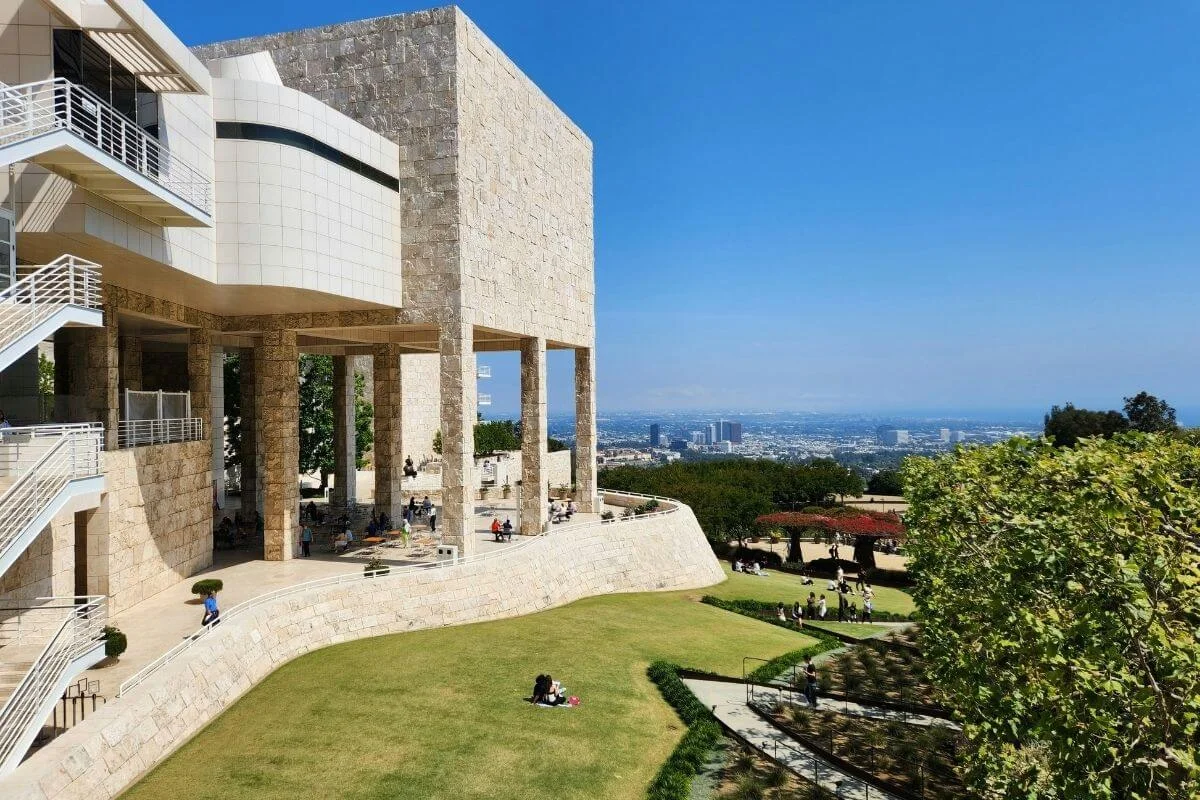
The Getty Center opened in December 1997 on a hilltop above Brentwood. You park at the bottom, ride a free tram up the hill, and step out into a campus of white travertine stone designed by Richard Meier, the Pritzker Prize architect who spent more than a decade building it.
This is the Getty most people mean when they say “the Getty.” It draws well over a million visitors a year, and on a clear day the terraces give you views from the Pacific to the San Gabriel Mountains, among the best views of the LA skyline you can get for free.
What You’ll See at the Getty Center
The collection covers European art from the Middle Ages to about 1900, spread across several pavilions. The pieces worth planning around:
- Van Gogh’s Irises (1889), in the West Pavilion’s Impressionist gallery alongside Monet and Renoir
- The finest early Rembrandt collection in the US, anchoring the Old Master paintings, sculpture, and drawings
- Illuminated manuscripts and decorative arts, including French furniture from J. Paul Getty’s own collection
- One of the largest photography holdings in the country, more than 150,000 prints
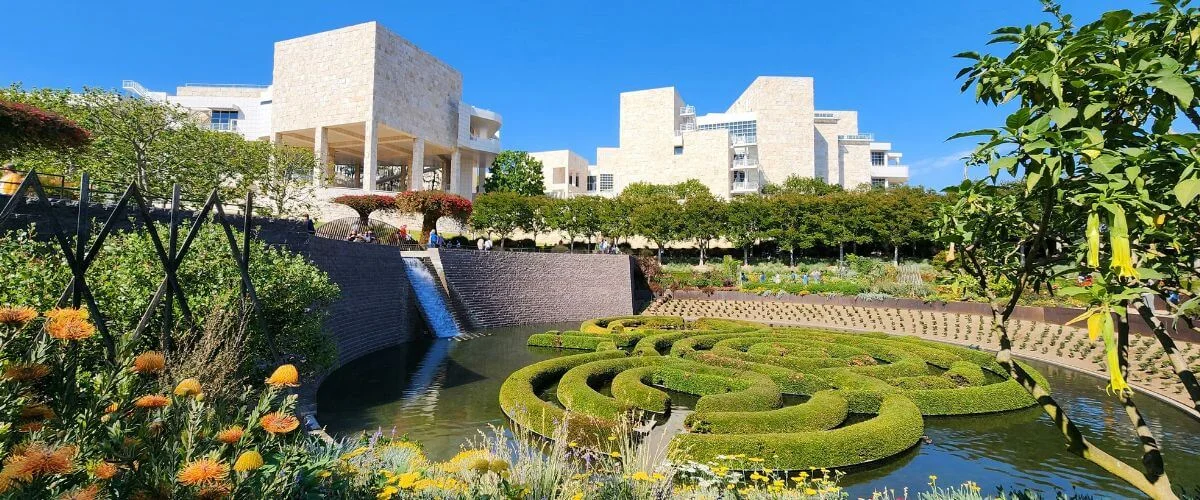
- Robert Irwin’s Central Garden, a living artwork with 500+ plant varieties and a stream that winds down to a pool of floating azaleas
The Center also rotates special exhibitions throughout the year, so there’s usually something new on top of the permanent collection.
If you’re building a museum-heavy trip, the Center anchors LA’s free museums worth booking ahead. Check the official Getty Center page for what’s on when you go.
Good to Know Before You Visit
The Getty rotates works on and off view and periodically closes galleries for renovation and reinstallation, so a specific piece you’re hoping to see may occasionally be off the walls. The core collection and the big draws stay accessible, and a quick look at the museum map before you arrive tells you which rooms are open on the day.
Getty Center Hours, Admission, and Parking
The Getty Center offers free admission, and you’ll need a timed-entry reservation booked online ahead of time.
- Hours: Tuesday to Friday and Sunday, 10am to 6:30pm. Saturday, 10am to 9pm. Closed Mondays.
- Parking: $25 per car, dropping to $15 after 3pm and $10 after 6pm, with free parking on Saturdays after 6pm.
- Amenities: an on-site restaurant, cafés, and a bookstore, alongside the gardens and terraces.
- Time to budget: Plan on 3 to 4 hours to see the pavilions, walk the garden, and take in the views without rushing.
The Getty Villa: Ancient Greece and Rome by the Sea
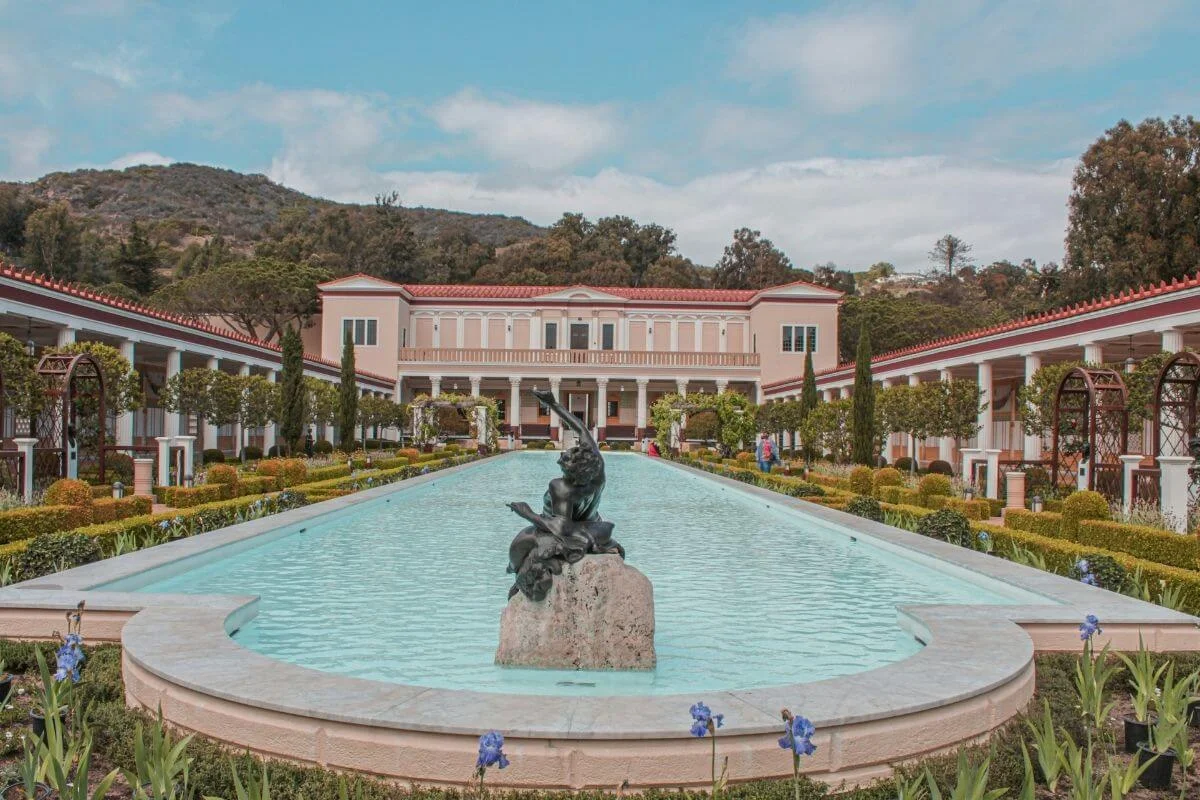
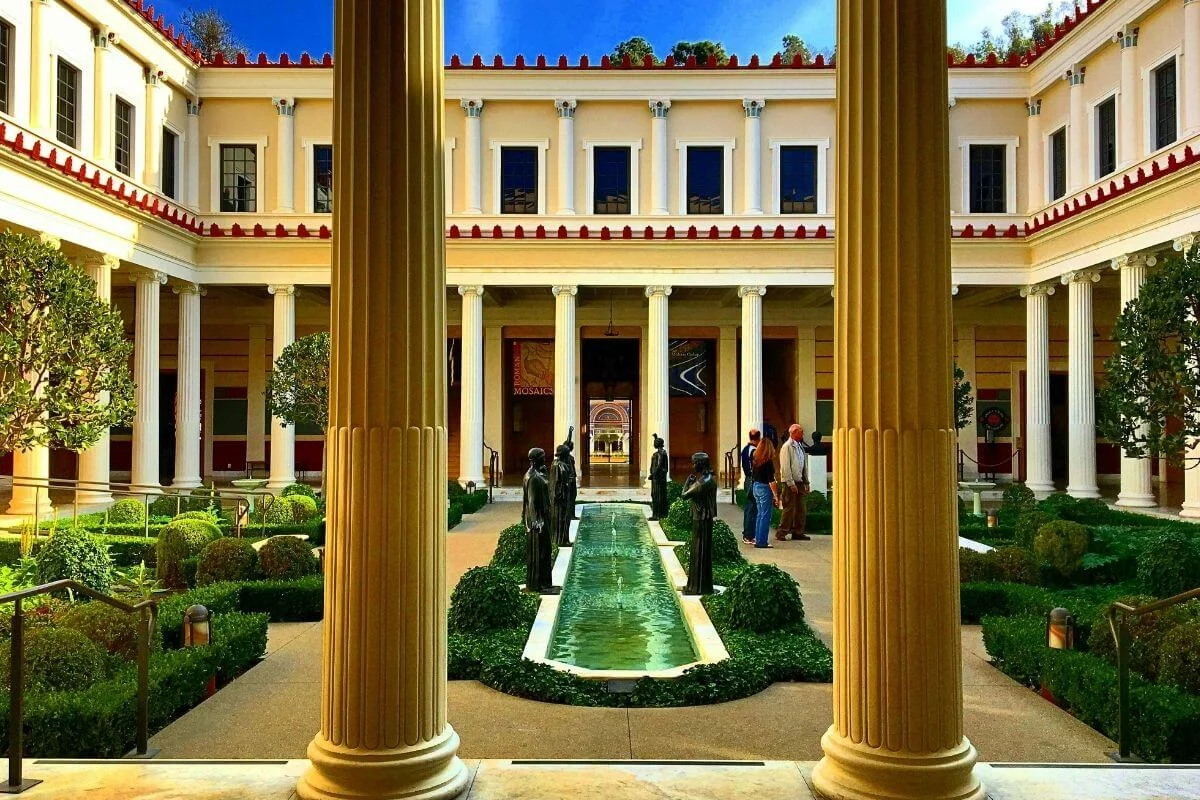
The Getty Villa is the original. J. Paul Getty built it in the early 1970s next to his Malibu-area home to house a growing collection of antiquities, and it opened to the public in 1974. The building itself is a re-creation of the Villa dei Papiri, a Roman country house in Herculaneum that was buried by Vesuvius, right down to the frescoes, bronze statues, and columned garden courtyards.
Everything here is ancient. Greek, Roman, and Etruscan art, tens of thousands of objects spanning thousands of years, shown in a setting built to match. Sitting in the Outer Peristyle garden with the reflecting pool and the ocean beyond, you feel further from modern LA than the 13 miles between the two Gettys would suggest.
What You’ll See at the Getty Villa
The Villa is smaller and more focused than the Center, and you can see it properly in a couple of hours rather than a full day. What fills the grounds:
- Greek, Roman, and Etruscan sculpture, in marble and bronze
- Painted vases and mosaics from across the ancient Mediterranean
- Everyday objects, jewelry, and coins from the ancient world, showing how people lived thousands of years ago
- The gardens, counted as part of the collection, with the Outer Peristyle pool and a working herb garden
- An outdoor Classical Theater that stages a Greek tragedy most years, so book early if a show is running during your visit
Getting to the Getty Villa
You can only turn into the Villa entrance from the northbound side of Pacific Coast Highway, the lanes heading up toward Malibu. Coming from Santa Monica, that’s a simple right turn straight in. Coming the other way, down from Malibu, you’ll pass the entrance and have to make a U-turn to reach it, since left turns across PCH aren’t allowed.
Public transit to the Villa is limited, which is the honest downside. If you’re weighing the trip, our guide to getting around LA without a car lays out the realistic options. The Villa also pairs naturally with more of LA’s coast and outdoor spots if you’re already headed up the shoreline.
Getty Villa Hours, Admission, and Parking
Like the Center, the Villa is free and requires a timed-entry reservation, and weekend slots fill up.
- Hours: Daily, 10am to 5pm. Closed Tuesdays.
- Reservations: Free, booked online or by calling (310) 440-7300. Reserve as soon as your dates are set.
- Parking: $25 per car, dropping to $15 after 3pm.
- Time to budget: Around 2 to 3 hours covers the galleries and the gardens comfortably.
You can confirm current details on the official Getty Villa page before you go.
Which Getty Should You Visit?
If you only have time for one, match the museum to what you came to see.
Choose the Getty Center If
You want variety and the big-ticket paintings. The Center suits you if you’d rather see Van Gogh, Monet, and Rembrandt than Roman sculpture, if you love modern architecture and gardens, and if those panoramic city views are high on your list. It’s also the easier of the two to reach without a car, and it gives you more to do across a half-day.
Choose the Getty Villa If
Ancient history is your reason for coming. The Villa is the pick if Greek and Roman antiquities light you up, if you want a calmer, more focused visit, and if the setting matters as much as the art. It’s smaller, quieter, and more atmospheric, and the ocean-side gardens are hard to beat on a warm afternoon.
Can You Do Both in One Day?
You can, though it’s tight, and for a first-timer on a short trip we usually steer people toward one. They’re 13 miles apart with LA traffic in between, both need separate timed reservations, and the Villa closes on Tuesdays while the Center closes on Mondays.
If you’re set on both, do the Villa in the morning when it opens at 10am, then the Center in the afternoon since it stays open later. Check the parking policy too, in case a same-day rate applies across both sites.
A gentler version is to pair one Getty with something nearby instead. The Villa fits with a coast day, and the Center sits on the westside near Santa Monica and Brentwood.
Seeing the Getty Without Losing Your Whole LA Trip
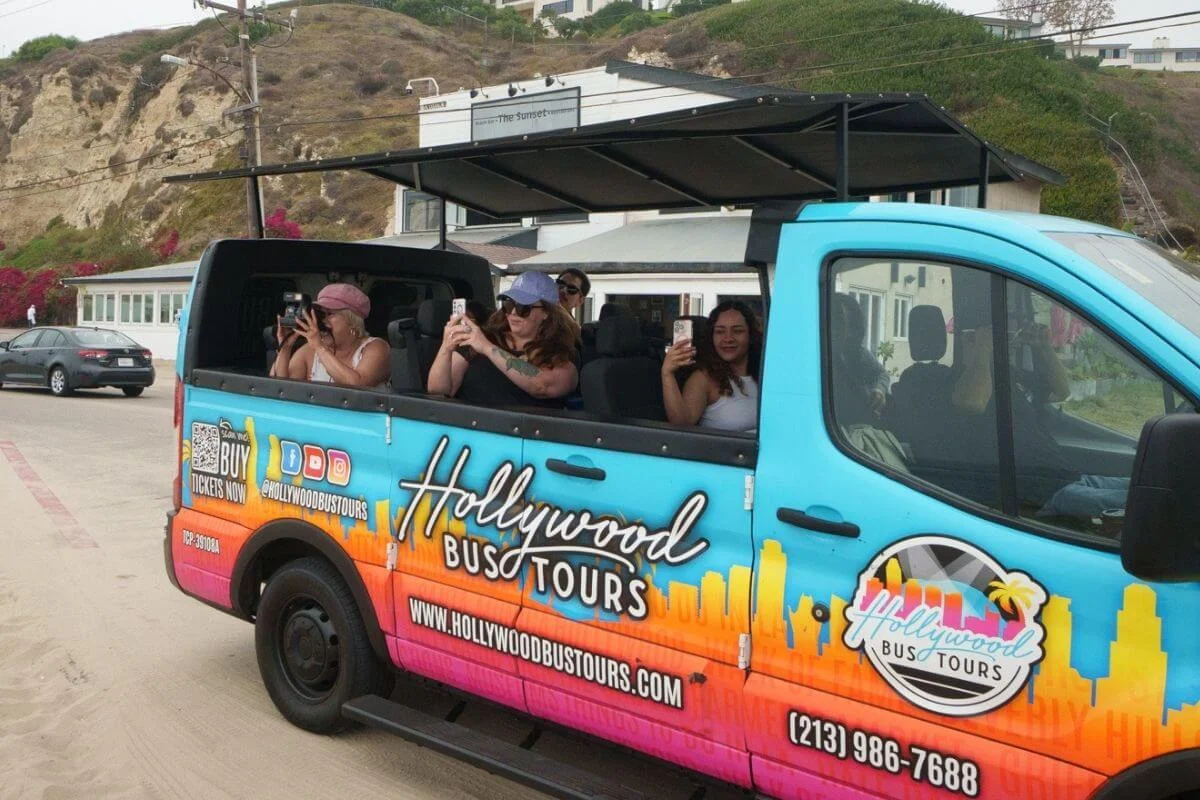
You’ll want at least half a day for the Getty Center on its own. That’s why having the rest of your LA must-sees handled in one loop matters, and it’s what our Half Day Best of LA Tour does.
One guided route covers Beverly Hills and Rodeo Drive, the Santa Monica Pier, The Grove, and Griffith Observatory with its Hollywood Sign views, so you’re not driving, parking, or guessing your way around the city.
Do the tour on one day and keep a Getty morning for the next, and a short trip suddenly holds a lot more. With 20,000+ five-star reviews, our guides know how to move through LA so your time goes to the sights, not the traffic.
For help slotting it all together, our first-timer’s LA itinerary is a good place to start.
Frequently Asked Questions
Is the Getty Center or Getty Villa better?
Neither is objectively better, they show different art. Pick the Getty Center for European paintings, photography, and city views, and pick the Getty Villa for ancient Greek and Roman antiquities in a re-created Roman house. Both are free to enter.
What is the difference between the Getty Center and the Getty Villa?
The Getty Center in Brentwood is a general art museum covering European work up to about 1900, set in a modern travertine campus with gardens and views. The Getty Villa in Pacific Palisades focuses only on Greek, Roman, and Etruscan antiquities, housed in a re-creation of an ancient Roman country house.
Are the Getty Center and Getty Villa free?
Yes, admission to both museums is free. Each one requires a free timed-entry reservation booked in advance, and parking costs $25 per car, dropping to $15 after 3pm.
Do you need a reservation for the Getty?
Yes, both the Getty Center and the Getty Villa require a free timed-entry reservation, which you book online or by phone. Weekend slots at the Villa fill up quickly, so reserve as soon as your travel dates are set.
Can you visit both the Getty Center and Getty Villa in one day?
It’s possible but tight, since the two are 13 miles apart, each needs its own reservation, and their closed days differ. If you attempt both, visit the Villa in the morning and the Center in the afternoon when it stays open later.
How do you get to the Getty Villa?
The Getty Villa sits on Pacific Coast Highway in Pacific Palisades, and you can enter only from the northbound right-hand lane, so you approach from the south. Coming from Santa Monica it’s a direct right turn, while from Malibu you pass the entrance and make a U-turn. Parking is $25 per car and public transit is limited, so most visitors drive or use a rideshare.
How much is parking at the Getty?
Parking at both the Getty Center and the Getty Villa is $25 per car, dropping to $15 after 3pm. At the Center it falls to $10 after 6pm and is free on Saturdays after 6pm. Admission itself is free at both sites.
How long should you spend at the Getty Center?
Plan on 3 to 4 hours at the Getty Center to see the main pavilions, walk Robert Irwin’s Central Garden, and enjoy the terrace views. The Getty Villa is smaller and takes closer to 2 to 3 hours.